A customer in Manchester used to type “plumber near me” and scroll through ten blue links. Today, more and more of them ask a question instead, and an AI writes the answer: “Here are three well-reviewed plumbers in Manchester who offer same-day repairs…”
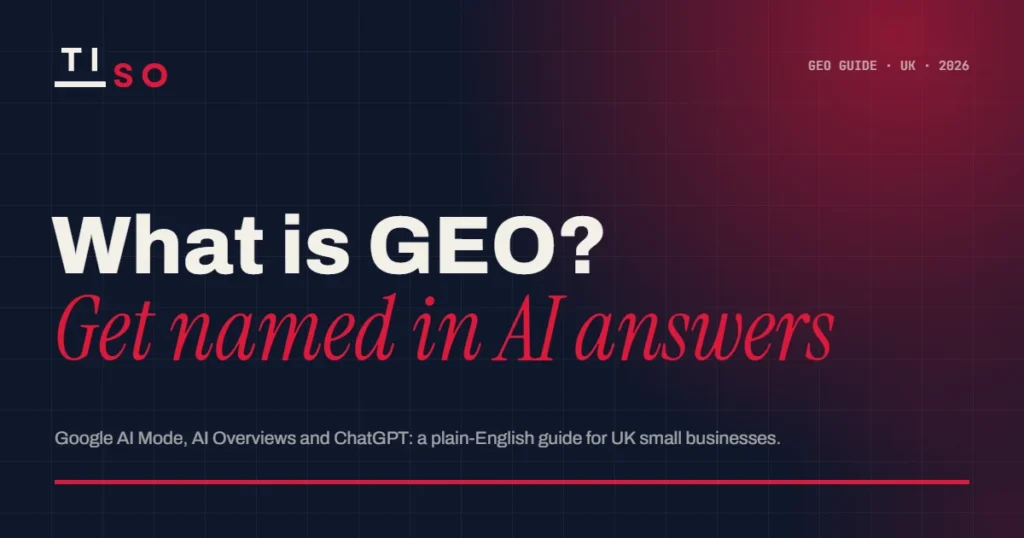
If your business is in that answer, you win the enquiry. If it isn’t, you may never know the customer existed. That is what GEO is about.
What is GEO?
GEO (generative engine optimisation) is the work of making your business easy for AI tools to understand, trust and recommend. The “generative engines” are tools that write answers rather than list links: Google AI Mode and AI Overviews, ChatGPT, Perplexity, Gemini and Copilot.
You will also hear it called AIO (AI optimisation) or AEO (answer engine optimisation). The names differ; the goal is the same: be the business the AI names.
Why does GEO matter now?
At Google I/O in May 2026, Google said AI Mode had passed one billion monthly users. And in September 2026, AlsoAsked data analysed by Mark Williams-Cook showed that 97% of “People also ask” answers in a sample of 19.2 million English results were AI Overviews, up from 86% a month earlier.
In plain terms: a growing share of the questions your customers ask Google are answered by AI before anyone clicks a website. The businesses those answers cite are getting the visibility.
Is SEO dead now that AI answers questions?
No, and I would be wary of anyone who says it is. What has changed is what SEO rewards. Ten years ago you could rank by repeating keywords and collecting links. Today Google and AI assistants try to understand what a page means and whether its author can be trusted, then build an answer from the sources that pass that test.
That shifts the work from tricking a system to explaining your business clearly: who you are, what you have done, and why your advice is reliable. Google’s own guidance on helpful, people-first content says the same thing. In practice the pages that AI cites are usually pages that already do well in ordinary search, which is why I treat GEO as a layer on top of SEO rather than a replacement for it.
SEO vs GEO: what’s the difference?
| SEO | GEO | |
|---|---|---|
| Goal | Rank in the search results | Be named or cited in AI answers |
| What you win | Clicks to your website | Recommendation and trust, often before the click |
| Main signals | Relevance, links, speed, technical health | Clear facts, consistency, reviews, mentions on trusted sites |
| How to measure | Google Search Console, rankings | Testing real prompts in AI tools; branded searches and enquiries |
The important part: GEO builds on SEO; it does not replace it. AI answers draw heavily on pages that already rank and are already trusted. A slow, thin website with no structure will struggle in both.
What does GEO involve?
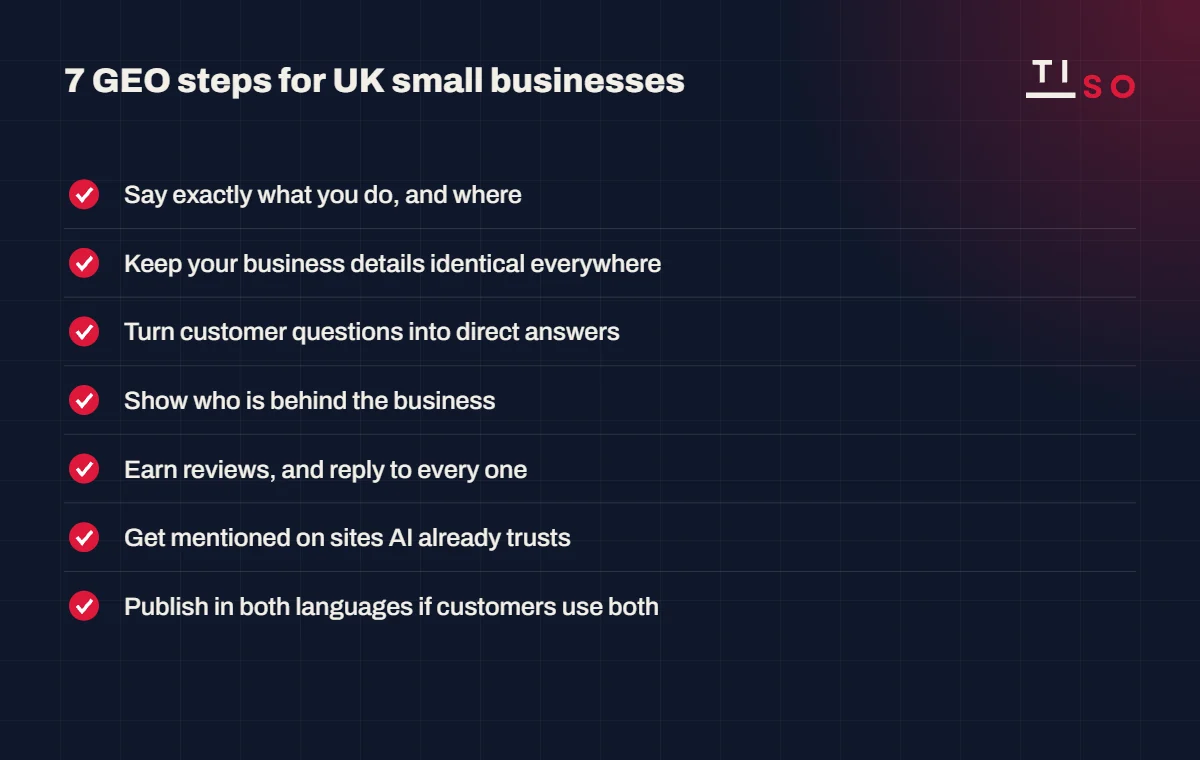
A GEO programme for a small business usually covers seven areas: clear service and location pages, consistent business details across the web, answer-ready content with structured data, visible people and credentials, reviews, mentions on sources AI already trusts, and content in every language your customers use.
Each one sounds simple. The hard part is knowing which pages, questions and sources matter for your sector and area, and checking what AI tools actually say about you, which changes month to month. That takes testing across several AI tools, in both languages, and it is where most do-it-yourself efforts stall.
Why don’t most small businesses show up in AI answers?
When we test AI answers for UK small businesses, the same gaps come up again and again:
- The website never says plainly what the business does, and where. AI cannot recommend what it cannot describe.
- Business details differ across Google, directories and social profiles. AI is less confident about a business it cannot pin down.
- Customer questions are answered on the phone, not on the website. So there is nothing for AI to quote.
- Few recent reviews and no third-party mentions. Competitors with stronger trust signals get named instead.
None of these is visible from your own website. You only see them by looking at your business the way AI does.
How to see your AI search visibility in Search Console
Until recently, the only way to know whether AI Overviews or AI Mode showed your site was to check by hand or rely on third-party estimates. In 2026 Google added generative AI performance reports to Search Console, and by the end of August they had rolled out to sites worldwide.
The report shows impressions from AI Overviews and AI Mode combined, broken down by page, country, date and device. It does not yet show clicks, position or the queries behind each impression, and smaller sites may not see it until they have enough AI impressions. Even so, it is the first data Google itself gives you on AI visibility.
When we report to clients, I now look at three layers together:
- Search visibility: rankings, impressions and clicks in normal results.
- AI visibility: which pages appear in AI answers, in which countries and on which devices.
- Business outcome: calls, enquiries and bookings, which is what actually matters.
A page with modest search traffic that is regularly shown in AI answers may still be building awareness and branded searches that turn into enquiries later. Without the second layer, you would never know.
How Tiso Digital helps you get named by AI
- AI visibility check. We test the questions your customers ask in Google AI Mode, AI Overviews and ChatGPT, in English and Chinese, and record who is named today.
- Priority plan. You get a short, plain-English list of what is holding you back and what to fix first.
- We do the work. Service pages, structured data, business listings, review process and bilingual content, handled by our team.
- Monthly tracking. We re-test the same prompts every month, so you can see whether AI is naming you more often.
Tiso Digital is a London-based SEO, GEO and web design team, named Best SEO & Digital Marketing Services Provider 2026 – UK by Acquisition International.
Frequently asked questions
Is GEO replacing SEO?
No. AI answers lean on pages that already rank and are trusted, so SEO is the foundation. GEO adds clarity, consistency and third-party trust on top.
How long does GEO take to work?
Some fixes, such as business details and clear answers on your website, can be done within weeks. Reviews and mentions on trusted sites build up over time. Most businesses should judge progress over three to six months.
Can I do GEO myself?
You can fix the basics yourself. The harder part is finding out what AI tools say about you and your competitors, and which sources they rely on in your sector. That needs regular testing across several tools and languages, which is why most businesses start with a professional check.
Can I pay to appear in AI answers?
Not in the organic AI answer itself. Google does show ads around AI features, but being cited in the answer has to be earned.
How much does GEO cost?
It depends on your starting point: a business with a strong website and good reviews needs far less work than one starting from scratch. We give you a clear quote after the free AI visibility check.
Find out what AI says about your business
In a free AI visibility check, we test the prompts your customers use, show you who AI recommends today, and tell you what to fix first.
Book a free AI visibility check or message us on WhatsApp.
Sources: Google introduces AI-enhanced search features at I/O 2026 (RTTNews via Nasdaq, May 2026); Almost all People Also Ask results are Google AI Overviews (Search Engine Roundtable, September 2026, citing AlsoAsked data); Creating helpful, reliable, people-first content (Google Search Central).

Eric Lee
Founder & CEO, Tiso Digital
Eric Lee founded Tiso Digital to give small and medium-sized businesses the kind of senior digital strategy usually reserved for large brands. He has spent more than a decade designing websites, leading SEO programmes and, more recently, helping businesses appear in AI-generated answers.
Meet our founder